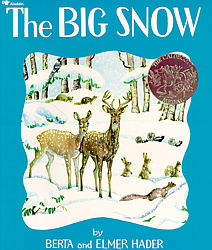
T"The Big Snow"T
Written and Illustrated By: Berta and Elmer Hader
Website Created By: Stacey Carmichael and Katie Crosby
Grade Level:
TThis super snowy activity page is for 4th graders!!
About the Book:
T This story is an adventurous look into the life and survival of animals in the forest. The variety of animals throughout the story all have a different ways of dealing with the problems of winter. The animals are encouraged by a man and his wife who provide food in hopes of the animals' survival through the "big snow." How do the animals find food? You will have to read this book to find out!
About the Author:
TBerta and Elmer Hader live in the country near the Hudson River. They have experienced many hard winters. The snow storms that they have experienced have been so bad that they have not been able to leave their home. You can read many other books written by the Haders. These books include: Snow in the City, The Farmer in the Dell, and The Mighty Hunter.
Before the Snow Storm:
T This is a KWL chart. Fill in what you know and then fill in what you want to know about the book. Then read "The Big Snow." After reading "The Big Snow," write in the last column what you have learned from the book.
|
Knowledge |
Want to Know |
Learned |
|
T I know that… |
T What happens when… |
T I learned… |
|
|
|
|
|
|
|
|
TWrite what you would do to survive a big snow storm? Use a piece of paper provided to write about where you would live, what you would eat, who you would visit, and how would you stay warm.
THelp make our classroom a winter wonderland! Go to this link and print off the snowflake. Color the snowflake that you printed off and then go ahead and cut it out.
Surviving the Storm:
TBefore your teacher reads this book, print off this worksheet of scrambled words. While your teacher is reading, see it you can unscramble the words!
TWhile your teacher is reading "The Big Snow," be sure to listen carefully for words you don't know. Choose one word you don't recognize and write it down on your snowflake that you cut out. After the book has been read and you have written your words, your teacher is going to post them around the room (maybe hung from the ceiling, on the students' desks, or on the wall). Some of the words may be repeated, but that's okay, that is more practice for you.
After the Snow Falls:
TA fun activity that is great for indoor play after reading this chilly book is this snowman jigsaw puzzle that can be found at:
TGet ready to go outside! Quietly talk about what you would wear outside in the snow with one of your classmates. Once that is done get ready to make goggles because you want to keep your face warm! Print off this link for directions. If you need any help please ask your teacher!
TPrint off this link and work with your class to make snow!
TPlease grade yourself with this rubric:
| Student Name: ________________________________________ | ||||||
| CATEGORY | 4 | 3 | 2 | 1 | ||
| Follows Along | Student is on the correct page and is actively reading along (eyes move along the lines) or finger is following words being read aloud by others. | Student is on the correct page and usually appears to be actively reading, but looks at the reader or the pictures occasionally. Can find place easily when called upon to read. | Student is on the correct page and seems to read along occasionally. May have a little trouble finding place when called upon to read. | Student is on the wrong page OR is clearly reading ahead or behind the person who is reading aloud. | ||
| Comprehension | Student seems to understand entire story and accurately answers 3 questions related to the story. | Student seems to understand most of the story and accurately answers 2 questions related to the story. | Student understands some parts of the story and accurately answers 1 question related to the story. | Student has trouble understanding or remembering most parts of the story. | ||
| Participates Willingly | Student routinely volunteers answers to questions and willingly tries to answer questions s/he is asked. | Student volunteers once or twice and willingly tries to all questions s/he is asked. | Student does not volunteer answers, but willing tries to answer questions s/he is asked. | Student does not willingly participate. | ||
| Completing Projects | Student completes his or her work with their best effort | Student completes all of their work but has a few errors. | Student only completes a couple (3 or less) projects. | Student does not complete all the projects. | ||